Deep Plane Facelift and Neck Lift: Why it is important for you to send us your younger photographs
Deep Plane Facelift and Neck Lift: Why it is important for you to send us your younger photographs
We have discussed “How we Age” in our article where we covered the important contributions of genetics, the two aging spurts, environment (sun damage, smoking, drugs, alcohol, lifestyle, etc) and illness. With these different factors at play, it is impossible to predict the exact course of aging of the face and neck without reviewing photographs from younger days. We generally like to see photographs from the age of 16 years onward, but sometimes, younger photographs also help (for example, there may be evidence of congenital abnormalities like ptosis, asymmetry, or other conditions).
It is best to take copies of photographs from childhood onward on your phone and send them to us with a rough idea of the age.
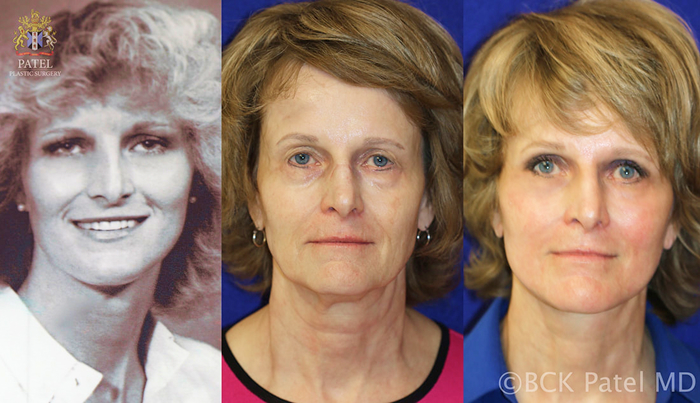
By studying the younger photographs, we were able to reverse time and actually make this lovely lady look even better than when she was in her early 20s, as she had some brow ptosis and ptosis even at that early age. We reversed that and gave her back her beautiful jawline and neck, as well as removed the baggy lower eyelids and reformed her gorgeous cheek fullness
Structural Changes to the Face
Some people develop jowls and a weaker jawline even as early as the 30s. Others may have a weak chin or a fuller neck, even when younger. The bone structure can be assessed more accurately in the younger photographs so that surgical planning can take into account any accentuation of the bones (cheeks, chin, jawline) that may be beneficial.
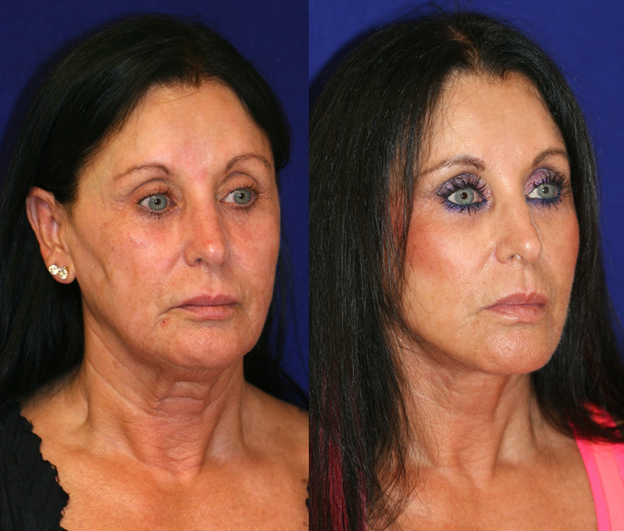
Natural results with a deep plane facelift and neck lift
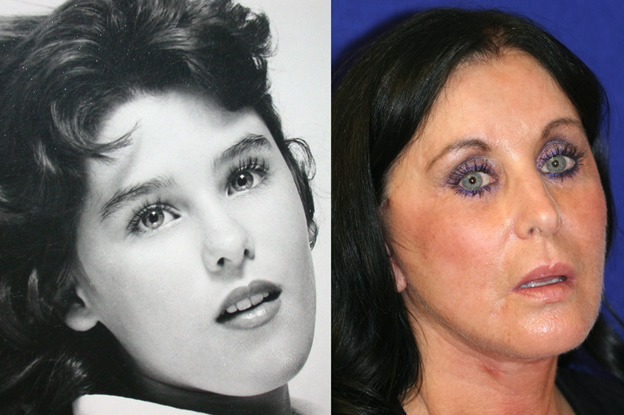
In other cases, we can aim to make the neck look even better than when the patient was in their 20s (by studying the fat compartments, jawline, and profile views). The extent of skin changes related to sun exposure, smoking, lifestyle and other factors can be assessed so that we can plan to improve the condition of the skin of the face, neck, and chest before undertaking surgery, but also during surgery with appropriate lasers, nano fat grafts, and injection of serum-extract and fat-extract stem cells. Beautiful skin makes the face and neck look all the more beautiful.
This is why we study photographs from younger days. Recreating brow positions, eyelids, cheeks, lips, jawline, and neck to match those from 50 years before!