The modern deep plane facelift and neck lift give very pleasing results with a natural look and avoid the stigmata of facelift surgery. The aim is to achieve beautiful, natural results with quick healing and for recovery to be as comfortable as possible. With the deep plane facelift, we use nano fat grafts, fractionated lasers, and serum extract applications that contain stem cells to give our patients the best possible skin. Invariably, these advanced techniques will create swelling, and healing requires good perfusion to all the layers: muscles, fascia, SMAS, skin, etc. We mix special creams for our patients to speed up the healing of the skin. Other advanced technologies can enhance healing and include the use of hyperbaric oxygen therapy after facelift and neck lift surgery.
A Brief History of Hyperbaric Oxygen Therapy
1662
The initial concept of hyperbaric medicine was invented in 1662 by a British physician, Dr. Nathaniel Henshaw. He built the first pressurized chamber (sealed wooden chamber powered by organ bellows!), which he called the “Domicilium” (from the Latin “domus” meaning house). He designed it to treat “pulmonary and digestive conditions,” although the exact success or otherwise is not accurately recorded!
1670
Sir Robert Boyle studied and documented the effects of changing air pressure on living tissue using a vacuum chamber in his experiments.
1788
Compressed hyperbaric air was used for the first time in a diving bell for underwater repair, and this led August Siebe to develop the first deep-sea diving suit in 1819.
1834
Dr. Junot designed the first true hyperbaric tank.
1830s
France experienced a renaissance in “pressure therapy,” during which Pneumatic Institutes and compressed air baths were established in health resorts across France and Europe and were promoted for respiratory and “other” ailments.
1839
Jacques Triger, a geologist and engineer, developed pressurized shafts for underwater mining. In these “Caissons,” he first observed the symptoms of “the bends” in humans. The bends were subsequently called “Caisson Disease.” In the late 1800s, deep-sea divers, naval workers, and even Brooklyn Bridge construction workers developed Caisson Disease, caused by surfacing too quickly. This led to the development of hyperbaric chambers so that divers may decompress more gradually. Mobile chambers were developed, which were shuttled across European cities and used to treat various maladies.
Early 1900s
Previously, hyperbaric chambers had been made of wood and used bellows to force air, rather than oxygen, into the chambers. With the Industrial Revolution and the increase in steel availability along with advances in pressure management, oxygen was used in the first true hyperbaric oxygen chambers made out of steel rather than wood.
1908
Dr. John S. Haldane is referred to as the “Father of Oxygen Therapy,” as he studied the effects of compressed oxygen and went on to develop dive tables for the British Royal Navy. The first scientific decompression schedules were developed, which were then improved to create the 1916 U.S. Navy Diving Manual, which is still used as a standard for decompression algorithms.
French doctors in the 1900s discovered that patients undergoing hyperbaric-assisted surgery recovered more quickly and experienced fewer complications. In 1918, Dr. Orval Cunningham made the important observation that the mortality rate of flu patients was better at lower altitudes because of the different oxygen levels. This led him in 1928 to create a five-story chamber with 60 rooms to treat flu patients in Cleveland, Ohio, which was called the Cunningham Sanitarium. Dr. Cunningham used pressurized air but made many outlandish claims about the efficacy of the treatments, which led to the Cunningham Sanitarium closing within a decade and to much suspicion in the medical community about claims of outcomes when pressurized air or oxygen were used in treating patients.
1928
Harvard Medical School built its first hyperbaric chamber.
1939 – 1945 (World War II)
War is the father of many advances in medicine, surgery, and affiliated fields. With submarine warfare and high-altitude flying came advances in understanding the effects of pressure on humans. The treatment of decompression sickness was refined into a sophisticated treatment routine rather than treated as an emergency.
1960s
Carbon monoxide poisoning and diving accident victims were successfully treated using hyperbaric oxygen therapy (HBOT) in the 1960s, which led to major research into the effectiveness of HBOT for numerous conditions.
1967
UHMS: The Undersea and Hyperbaric Medical Society is formed to oversee hyperbaric medicine and diving medicine. UHMS is strongly affiliated with the U.S. Navy and now offers training and accreditation in hyperbaric nursing and hyperbaric technology, as well as certification for physicians and accreditation for facilities.
1984
Fire safety standards in HBOT facilities were published by the National Fire Protection Association (NFPA) and incorporated into the Health Care Facilities Code in 1984.
What Is Hyperbaric Oxygen Therapy (HBOT)?
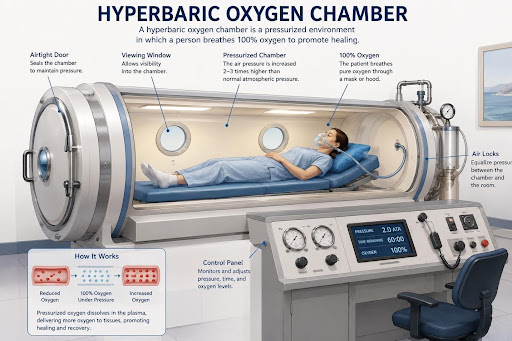
HBOT involves 100% pure oxygen in a pressurized chamber, where the patient breathes at 1.5 to 2.5 times the normal atmospheric pressure. Under these circumstances, the lungs can absorb more oxygen, as much as up to 15 times more than in normal circumstances. This increased oxygen is delivered to the tissues through the bloodstream.
The 2019 Nobel Prize in Physiology focused on “How cells adapt to oxygen availability” and helped us understand how oxygen enables tissues to repair and regenerate at the mitochondrial and cellular levels. The science of hyperbaric oxygen therapy has advanced greatly since that seminal work in the 1990s by William Kaelin, Sir Peter Ratcliffe, and Gregg Semenza.
HBOT treatment has been approved by the FDA for 13 conditions and includes the treatment of chronic wounds, radiation injuries, carbon monoxide poisoning, diabetic ulcers, and severe burns. Further research into the treatment of neurological conditions, for stroke recovery, long COVID symptoms, and traumatic brain injury is ongoing and holds great promise.
In the postoperative period, increased oxygen enhances healing by promoting the formation of new blood vessels, suppressing inflammation, boosting immune function, and accelerating tissue repair at the cellular level. In cosmetic surgery, faster healing and reduced downtime are observed when HBOT is used, and specific studies are currently ongoing.
Hyperbaric Oxygen Therapy (HBOT) in Facelift Recovery
Natural-looking results are now possible using the modern deep plane facelift techniques. In these techniques, the tissues from the skin to the SMAS to the deeper muscles are repositioned. Furthermore, the surface changes of aging improved with the use of fat grafts, nano fat grafts, stem cells, and fractionated lasers. The lymphatic and vascular components of the tissues invariably get affected, and tissue healing requires:
- Optimal conditions of no excessive tension
- Care when creating skin flaps
- Appropriate vectors of lifting
- Careful anatomical dissection with preservation of the vascular and nerve supplies in the face
Most patients see the swelling and the bruising, but there is healing of the deeper tissues, repositioned muscles, fascia, skin, fat, fat grafts, etc. During the healing phase, any improvement in tissue oxygenation and control of inflammation, together with improved lymphatic flow can have a noticeable impact on the speed of healing and comfort.
The Science of Hyperbaric Oxygen and Tissue Healing
After facelift and neck lift surgery, there is an inflammatory phase followed by tissue remodeling and regeneration. Hyperbaric oxygen therapy after such surgery helps in the following ways:
1. Accelerated Wound Healing
Tissue healing after surgery requires oxygen for collagen synthesis and fibroblast activity. HBOT has been shown to saturate these tissues and enhance healing with improved tensile strength of incisions.
2. Reduced Swelling and Bruising
Swelling after a deep plane facelift and neck lift is caused by tissue dissection, tissue repositioning, and the use of fat grafts, nano fat grafts, stem cells, and lasers, among other interventions. The swelling is especially obvious in the cheeks, jawline, and upper neck. Hyperbaric oxygen therapy promotes vasoconstriction and enhances lymphatic drainage, helping reduce edema in these areas.
3. Anti-Inflammatory Effects
It has been shown that proinflammatory cytokines are downregulated by HBOT, while anti-inflammatory signals are upregulated. As this leads to more rapid reduction of inflammation, there is greater comfort and a more rapid reduction in the swelling. Persistent and irregular swelling can lead to irregularities in the face, especially where lymphatic flow is compromised.
4. Improved Blood Flow
Any surgical procedure will affect the blood flow to the operated region. This may be because of direct trauma, cauterization, pressure from swelling, or from dressings. An increase in the oxygen level to these tissues helps reduce swelling and also stimulates the formation of new blood vessels, which allows quicker restoration of the circulation and provides better nourishment to these recovering tissues.
5. Infection Prevention
The function of white blood cells is vital in fighting bacteria in the postoperative period. Oxygen enhances the function of white blood cells, leading to enhanced immune activity and active reduction of infections. Increased oxygenation has been shown to improve overall healing by accelerating the clearance of fluid and debris.
Hyperbaric Oxygen Sessions: Physical Locations
Hyperbaric oxygen chambers are present in many hospitals and also in numerous free-standing private centers. After cosmetic surgery, such as a deep plane facelift and neck lift, HBOT is administered in a single-person chamber (called a monoplace). These are comfortable, clear acrylic tubes in which patients can recline and listen to music or watch a screen during treatment.
Hyperbaric Oxygen Sessions: What Is Done?
During a typical session, the following occurs:
- Pressurization: Pressure is raised to around 2.0 atmospheres (2.0 ATA).
- Oxygen delivery: The patient breathes 100% oxygen for about 60 to 90 minutes.
- Decompression: Over 10 – 15 minutes, the chamber is slowly returned to normal pressure.
The experience is generally described as relaxing. It is painless, although mild ear popping may occur (akin to airplane altitude changes).
When should hyperbaric oxygen therapy be started after a facelift?
We recommend that our patients commence treatments after 2 to 3 days to allow the initial phase of the swelling to settle and for the patient to recover from the effects of the anesthesia. We generally recommend 5 to 6 daily treatments, though some centers offer a 10-treatment package at a very reasonable price. Treatments can be administered daily or every two days. Patients who have diabetes or have a history of vascular disease or smoking should receive a series of 10 treatments and may start the treatments the day after the surgery.
Does everyone recovering from a deep plane facelift and neck lift benefit from hyperbaric oxygen therapy?
The short answer is yes, everyone can benefit from receiving HBOT after a deep plane facelift and neck lift. However, certain patients should absolutely receive such sessions. These include patients who:
- Have diabetes or vascular disease
- Have a history of poor healing
- Are at advanced age with circulation problems
- Are undergoing a repeat or revision facelift
- Have a prior history of irradiation to the head or neck
- Specifically want to recover more quickly because of social or work commitments
HBOT is commonly used by performers and patients in the public eye, even after more limited procedures than a deep plane facelift.
What does clinical research have to say about the use of HBOT after deep plane facelifts?
Ongoing studies are shedding light on the healing process after facelifts.
- A 2023 comparative study published in the Oxford University Press showed a significantly shorter time to wound healing in patients undergoing HBOT when compared to a group that did not receive HBOT after the facelift.
- A 2020 study published in Plastic and Reconstructive Surgery found that HBOT significantly reduced bruising and swelling in patients after facial cosmetic surgery compared to standard recovery protocols.
- A 2016 review in Aesthetic Surgery Journal noted that HBOT may reduce flap necrosis and skin loss in facial surgery patients, particularly those with risk factors like smoking.
There are ongoing trials investigating the effects of HBOT on the quality of scars, the complication rates and patient satisfaction after facial surgery.
What other effects of HBOT have been noticed?
Patients have noticed other benefits after HBOT treatment, including:
- A speedier recovery from anesthesia with a clearer mind (reduction in brain fog, sometimes described by patients)
- Enhanced improvement in the collagen of the skin with improved texture and tone
- Quicker lymphatic flow, which gets affected by the dissection and tissue manipulation, helping with quicker resolution of the swelling
- Decreased vulnerability to infections
These added perks contribute to patients feeling better, faster, both physically and emotionally, after their procedure.
Are there any contraindications to recieving HBOT?
If you have had recent ear surgery or ear injury, please check with your treating physician before undergoing HBOT.
If you have a cold, fever or certain lung diseases, check with your treating physician before undergoing HBOT.
Is HBOT Safe?
When performed in a medical setting by trained professionals, HBOT is considered very safe. Side effects are rare and usually mild, including:
- Temporary ear pressure or discomfort
- Mild fatigue after sessions
- Sinus pressure or mild light-headedness
More serious risks, such as barotrauma, oxygen toxicity, or vision changes, are extremely rare and primarily associated with prolonged or improperly administered therapy. Patients with certain medical conditions (like untreated pneumothorax) may not be eligible, so a consultation with the treating physician is essential before starting therapy.
Where can I get my HBOT after my facelift?
We have negotiated special rates at several facilities in Salt Lake City and in St. George. We will provide you with a list of these facilities.
Planning Your HBOT After Your Facelift
- Plan ahead: It’s helpful to book sessions in advance, especially if you’re operating on a tight recovery timeline.
- Commit to a short series: For best results, plan on multiple sessions within the first 2–3 weeks after surgery.
- Sensible Habits: For the most comprehensive recovery, pair HBOT with other healthy habits, such as hydration, nutrition, sleep, and proper wound care.
Conclusion
Hyperbaric oxygen therapy is science-backed and offers known benefits to patients recovering from facial surgery such as a deep plane facelift and neck lift. Reduced swelling, quicker healing, healthier skin, and quicker incision healing are some of the benefits of HBOT.
HBOT is a useful adjunct to modern cosmetic and reconstructive facial plastic surgery and can speed up your healing.
Hyperbaric Locations in Salt Lake City
Restore Hyper Wellness
Vitalis Hyperbarics
Utah Body & Soul
iCryo
Hyperbaric Locations in St. George
St. George Hyperbaric/Red Light Therapy
- Mall Drive
- Phone: 435-627-6640
Hyperbaric Red Light Therapy
- Sunset Drive
- Phone: 435-525-3267
IHC Hospital Wound Care and Hyperbaric/Red Light Therapy
References